How does a gaseous fuel jet become a combustible mixture?
Fuel injection is only part of mixture formation. The surrounding air motion influences how a transient jet spreads and mixes, and how a flammable mixture develops in time and space.
My MASc research at the University of Windsor investigated gaseous-fuel injection using a modified KIVA-3V computational model. It examined turbulent mixing and organised air motion, including tumble and swirl, in configurations relevant to engine mixture formation.
A controlled setting for studying mixing
The original project describes a cubic chamber with oscillating perforated plates as a way to generate turbulence. A transient gaseous jet could then be examined under controlled background-flow conditions, including a zero-mean-velocity case.
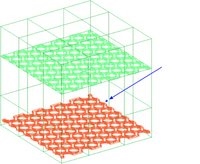
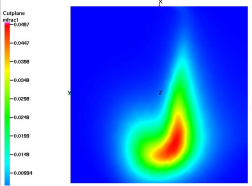
This setup separates the mixing question from many of the geometric complexities of a complete engine, making it easier to study the influence of the initial flow and injection conditions.
Tumble, swirl, and the timing of injection
Tumble and swirl organise the air motion in different ways. Their evolution changes the environment encountered by the fuel jet, so the initial circulation, injection timing, and injection velocity must be considered together.
The thesis examined hydrogen and methane in fixed-volume and moving-piston configurations. Within the conditions studied, hydrogen mixed more rapidly; tumble and swirl also evolved differently during the compression and expansion processes.
Related publications
The project led to conference contributions on transient gaseous-fuel jets, flammable-mixture formation, and the effect of tumbling or swirling air motion.
Gharib, N. & Sobiesiak, A. (2008). Flammable mixture formation and mixing rates of transient gaseous fuel jet with air in tumbling and swirling motion. Journal of KONES, 15(3).
Read the 2008 paper PDF ↗ (opens in a new tab)
See the complete archived bibliography →
Figures and research media from the original research archive (opens in a new tab). Research affiliations and project descriptions refer to the periods in which the work was undertaken.